
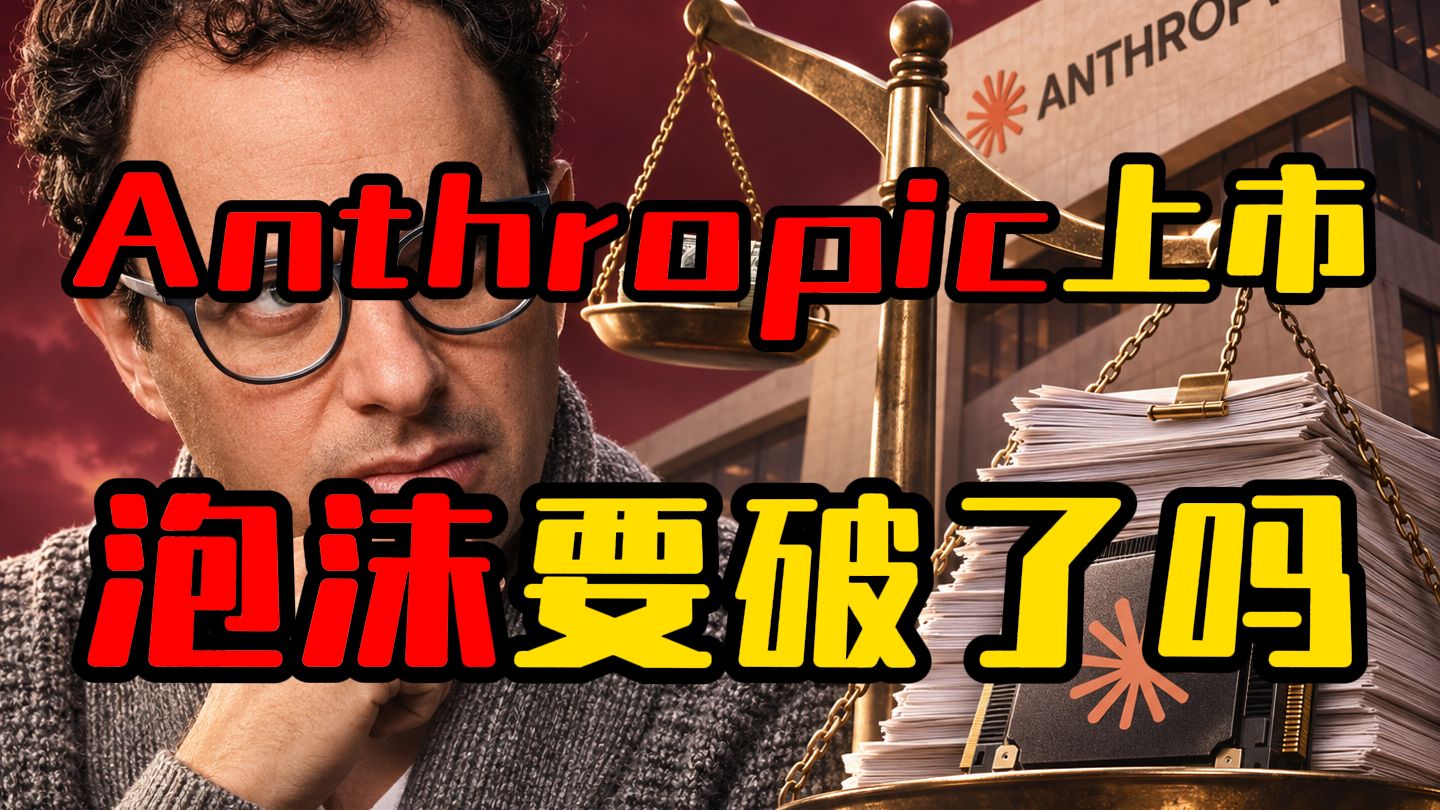
Anthropic — the famous "A company" — is finally going public. Some friends who don't follow AI may not have heard of this company, but as things stand, it should be ranked first in AI intelligence among all AI companies in the world.
In 2023, the company's full-year revenue was only 40 million US dollars, yet this year it is touting an IPO valuation as high as 1.4 trillion dollars — that is, 35,000 times its 2023 revenue. You heard that right: 35,000 times. So will Anthropic's IPO plan go smoothly, and why is it in such a hurry to go public this year?
In this episode, let's talk about this topic. First, Anthropic's revenue can be divided into two parts. The first is usage-based billing: enterprise customers call Claude through API interfaces and pay for what they use, accounting for 80% of total revenue.
The second is subscriptions: individual users pay 20 dollars a month for Claude Pro, or 100 and 200 dollars for Max, accounting for 20%. So simply put, Anthropic's real source of income is enterprises; individual users' membership fees are only a small share. This is also why the company is rather arrogant toward individual users — because its main customers are businesses.
In other words, it is a company focused on B-end users. Next, on growth: full-year revenue in 2023 was 41 million dollars; in 2024 it was 386 million, more than nine times the previous year; in 2025 it was 4.59 billion, about twelve times the previous year.
Then in 2026, by quarter: the first quarter was roughly 4.7 billion, the second quarter 11.56 billion — more than doubling quarter over quarter — and the third quarter was 16.96 billion. Note that the second quarter grew 144% over the first, but the third quarter grew only 47% over the second. Revenue is still hitting new highs, but the pace of growth has already begun to slow.
This is one of the risk points commonly cited by most investors. Now let's look at paying customers. Anthropic has more than 11,900 enterprise customers paying over 100,000 dollars a year, whereas a year ago that number was only 950.
More than 1,900 pay over 1 million dollars a year, and roughly 250 pay over 10 million dollars a year. Moreover, no single customer accounts for more than 10% of revenue, and the top five customers together account for about 25%, so the customer structure is fairly diversified. The prospectus also includes a metric called net revenue retention rate, which stands at 900%.
That means the same group of existing customers is spending nine times more this year than last year. So Anthropic's growth doesn't rely only on acquiring new customers — existing customers are also dramatically increasing their spending. By the way, in the first half of this year, 48% of Anthropic's revenue came through cloud marketplace channels.
Many enterprise customers don't buy Claude directly from Anthropic; instead, on cloud platforms like Amazon AWS, Google GCP, or Microsoft Azure, they check off Claude's services as if ordering from a menu. The cloud platform takes a commission and then passes the rest of the money on to Anthropic.
So for Amazon, Google, and Microsoft, they are not just Anthropic's partners but also its sales channels — nearly half of Anthropic's revenue passes through their hands. This is also why Anthropic's relationship with these companies is so extraordinary. Having covered revenue, let's talk about profit.
According to media reports available online, Anthropic's gross margin in the third quarter was about 85%, while ordinary software companies have gross margins between 70% and 80%. Judging by this number alone, Anthropic is a software company with very strong profitability.
But interestingly, that 85% figure was calculated by external analysts based on the financial statements. Whether it truly represents an 85% net margin, nobody actually knows. For example, under GAAP accounting, Anthropic shows losses approaching a hundred billion, because Anthropic frequently places large orders with many companies for compute leasing contracts.
As of the end of September, Anthropic held 95.6 billion dollars in cash plus 36.3 billion dollars in short-term investments, so it isn't short of money in the short term. However, these are only current expenditures; the real big money lies in the long-term bills it has signed. The revised prospectus disclosed a total of seven major compute procurement and leasing contracts.
Ranked from largest to smallest: Broadcom at 161.2 billion dollars, SpaceX xAI at up to 120.5 billion, Google at at least 114.5 billion, Amazon at at least 110 billion, followed by Microsoft at at least 44.9 billion, Nebius (N scale) at up to 44.6 billion, and Lambda at roughly 41.3 billion. These seven add up to roughly 637 billion.
Adding short-term procurement commitments and leases that haven't yet commenced, total commitments as of the end of September approach 900 billion — most of which are non-cancellable and must be paid whether or not the money is ultimately used. This is why people jokingly say that Miss Claude, who appears glamorous on the surface, is actually crushed under pressure.
With nearly 900 billion in liabilities, forget a company — if this were an ordinary country, it would go bankrupt on the spot. These contracts span seven to ten years, so for Anthropic, the expenditure side has already been locked in advance. It must — and can only — keep staying ahead; otherwise it cannot raise financing from the market and will inevitably default on the spot.
So Anthropic's choice to go public at this point in time is not some well-planned strategy. Especially in November, the Nasdaq 100 index has already fallen 14%, and the VIX index, which measures market panic, has also exceeded 25.
Most companies in this kind of market would most likely choose to postpone their IPO, but Anthropic did not postpone. The only possible answer is that it can no longer wait. In addition, the previous round of private financing was the Series H in June this year, at a valuation that had already reached 965 billion dollars — it's hard to find private investors online who could take on that size.
So the public market is basically the only place that still has sufficient capital. So the question is: with pressure this great, why sign such huge contracts at all? The answer is that buying compute on a short-term basis costs far more than signing long-term contracts — the 5 billion in short-term procurement mentioned earlier is an example.
So locking in compute in advance is basically the only way to reduce unit costs.
But this also means that once demand growth slows in the future, these contracts will become fixed expenses. Revenue can fall, but the bills won't come down with it. Of course, the companies willing to sign billion-dollar contracts with Anthropic aren't acting out of simple motives either.
Amazon plays three roles with Anthropic. The first is investor: from 2023 to 2025, Amazon bought $8 billion of convertible notes, and this year it bought roughly $10 billion of preferred stock, adding up to about $18 billion. The second is supplier: Anthropic signed at least $110 billion in AWS compute contracts, using Amazon's in-house Trainium chips.
The third is sales channel: enterprise customers call Claude through AWS's Bedrock platform, and after Amazon takes its commission, it passes the money on to Anthropic—this is part of the cloud marketplace revenue mentioned earlier. Connecting these three roles, the flow of money goes like this: Amazon invests money in Anthropic, Anthropic promises to spend $110 billion on AWS, customers buy Claude on AWS, part of that revenue returns to Anthropic, and Anthropic then uses that money to pay its AWS bills.
After going around in a circle, the money ends up back at Amazon.
The revaluation of the convertible notes produced huge paper losses on Anthropic's books, and some of those notes are held by Amazon. When Anthropic's valuation rises, the notes in Amazon's hands appreciate accordingly. So in the second quarter of this year, of Amazon's $53.4 billion in other gains, the bulk came from Anthropic.
In other words, from the same valuation increase, Anthropic booked a loss while Amazon booked a profit. In fact, for the very same notes, the two companies assigned different valuations: as of the end of September, Amazon valued them at $146.2 billion, while Anthropic valued them at $130.5 billion—a gap of $15.7 billion.
Next is Google as an investor. From 2023 to this year, Google invested roughly $23 billion in stages, with another $20 billion in committed funds not yet deployed, adding up to the package of up to $40 billion announced this April. As a supplier, Anthropic has committed to spending at least $114.5 billion on Google Cloud.
As a sales channel, Google sells Claude through its Vertex AI platform. Its three roles are almost perfectly symmetrical with Amazon's. According to Michael Burry's tally, of the roughly $141 billion Anthropic has raised in total, about $41 billion came from these two companies, Amazon and Google.
Microsoft and Nvidia came in together in November 2025. Microsoft committed up to $5 billion and Nvidia up to $10 billion, while Anthropic committed to purchasing $30 billion of Microsoft Azure compute. By the time of this prospectus, that figure had already become at least $44.9 billion.
The most typical example is Broadcom: Anthropic rents TPU equipment from Broadcom, with five-year rent of roughly $161.2 billion—the largest of the seven contracts. At the same time, Broadcom can subscribe to up to $42 billion of Anthropic convertible notes, with the stipulation that this money can only be used to pay Broadcom's rent.
On top of that, Broadcom brought in large investment institutions like Apollo to backstop the lease, up to $29 billion. Simply put, Broadcom lends you money so you can pay Broadcom's rent.
For this IPO, the prospectus lists seven participants: Google, Nvidia, AMD, Broadcom, Micron, Microsoft, and TSMC—essentially all Anthropic's suppliers or partners. How much each bought is not stated in the prospectus, so some media outlets joked that Anthropic's IPO is basically a group project of the entire AI industry chain.
AMD, for instance, had already committed as early as July this year to buy up to $5 billion of Anthropic stock, while Anthropic is expected to purchase more than $20 billion in chips from AMD.
Of course, this "stepping on your right foot to lift your left foot" game is not unique to Anthropic. In September 2025, Nvidia announced it would invest up to $100 billion in OpenAI, with funds disbursed in installments based on OpenAI's pace of deploying Nvidia chips.
But that agreement never materialized, and in February this year it was changed to an equity investment of roughly $30 billion—especially after Jensen Huang's troubles, this agreement is very unlikely to be fully honored. In October of the same year, OpenAI signed a contract with AMD to purchase 6 gigawatts of AMD chips, and AMD gave OpenAI warrants for up to 160 million AMD shares—that is, trading its own stock for orders.
Bloomberg produced a set of illustrated charts at the time specifically explaining these circular transactions between OpenAI and Nvidia and AMD. Add to that a roughly $300 billion five-year compute contract between OpenAI and Oracle, and the fact that Nvidia, while holding a stake in CoreWeave, committed to backstop-purchasing $6.3 billion of its idle compute capacity—and CoreWeave itself is a major buyer of Nvidia chips.
So Nvidia's position in this picture is: money earned from selling chips is reinvested in AI companies and compute companies, and those companies take the money they've obtained and continue to buy even more Nvidia chips.
Now stack all these relationships together: investors put money into OpenAI and Anthropic, the money is spent on compute, and the money for compute ultimately flows to Google, Amazon, Microsoft, Broadcom, and Nvidia—yet these companies are themselves the investors. So the investor, the supplier, and the sales channel are the same person or the same group of people.
Michael Burry, one of the real-life prototypes of the film The Big Short, wrote a dedicated article after the prospectus was made public. His point is that Anthropic's capital structure is a closed loop, and investors may be mistaking expansion sustained by supplier transfusions and debt for naturally growing demand.
He also cited a figure: for every dollar Anthropic spends on compute, the revenue it generates has fallen from $2.08 to $1.70. But to be fair, because there is a layer of genuine third-party customers paying in the middle—most of those more than 10,000 enterprise customers have no equity ties to the cloud vendors, and their spending continues to increase.
On top of that, Anthropic's customer base is itself fairly diversified, and Anthropic does genuinely have the ability to be profitable. The problem is simply that the prospectus doesn't disclose enough detail. Under prospectus rules, related parties are defined by voting rights, and both Amazon and Google hold non-voting shares, so they don't appear at all in the related-party transaction tables.
The prospectus also doesn't break out, by cloud provider, how much money Anthropic pays each one or how much revenue it earns through each one. As for how much of their own money these cloud providers spent buying cloud services—there's no way to look that up either.
Without those numbers, there's no way to calculate precisely how much of the money in this loop is new money coming in from outside, and how much is old money going around in a circle and coming back. Simply put, everyone knows you're inflating a bubble, and because AI really is impressive, people are willing to turn a blind eye. But you can't completely refuse to tell everyone how big your bubble actually is.
This model, where a supplier provides funding to customers who then use that money to buy the supplier's products, was not invented by the AI industry. Twenty-six years ago, the telecom industry did something very similar. Lucent—Lucent Technologies—was the world's largest telecom equipment maker in the late 1990s.
Its position in that era was roughly equivalent to Nvidia's today. What Lucent did was lend money directly to up-and-coming telecom carriers like Winstar Communications, so they could use those loans to buy Lucent's network equipment.
The financing figures vary somewhat depending on the source, roughly between 8.1 billion and 15 billion US dollars, but whichever number you take, the logic is the same: Lucent was using its own money to create its own revenue. The result was that financial reports and orders kept growing, but underneath, part of the demand didn't come from end users—it came from Lucent's own wallet. The market looked thriving.
Then in 2000, the dot-com bubble burst. Nearly all the carriers that had borrowed money went bankrupt, the loans turned into bad debt, and Lucent's stock fell from 84 dollars all the way down to 0.55 dollars. A similar case was Canada's Nortel Networks.
Nortel provided 3.1 billion dollars in customer financing, of which 1.4 billion was never recovered, and Nortel ultimately filed for bankruptcy in 2009. Cisco provided 2.4 billion dollars in customer loans; after the bubble burst, its stock fell from 80 dollars to 10 dollars, and 26 years later, Cisco's share price still hasn't returned to its 2000 peak.
The only difference this time is that the scale is bigger, the bubble is inflating faster, and the danger is more severe. It's no longer just investment institutions and retail shareholders who would lose money—it could drag down the US economy and even the global economy. Keep in mind that America's broad investment in AI has long since surpassed the trillion-dollar level and is approaching 10 trillion.
And this year, one mega-cap company has already gone through a similar IPO trajectory: SpaceX, which listed in June—exactly five months ago now.
SpaceX listed on June 12 at an offering price of 135 dollars. It opened at 150 dollars on day one and closed at 160.95 dollars, up 19%. Four days later, the stock surged to 225.64 dollars, 67% above the offering price.
One reason was that the shares tradable on day one represented only 4.2% of total shares outstanding—a small float is naturally easy to push higher. On July 7, SpaceX was added to the Nasdaq-100 index.
Under the fast-entry rule introduced in May this year, large-cap new listings become eligible just 15 trading days after going public, and funds tracking the index passively bought about 4.3 billion dollars' worth of SpaceX stock. But on the day of inclusion, the stock actually fell nearly 7%—that buying expectation had already been priced in, and once the news landed, it became a selling point instead.
By mid-July, SpaceX had fallen below its offering price. On October 30 it closed at 134.72 dollars, 28 cents below the offering price. From its peak to falling below the offering price took only about a month; from a 19% first-day gain to essentially back at square one took five months.
How many retail investors got wiped out, how many small institutions lost everything—only the people on the rooftop know.
Returning to Anthropic: its trajectory after listing will depend on several key indicators. On November 17, Nvidia releases its earnings report—right on the day before pricing—which will directly affect sentiment across the entire AI sector. And just recently, Jensen Huang was dismissed, Nvidia's stock plunged, and he's due to be subpoenaed on the 18th.
Anthropic prices on November 18 and begins trading on November 19. Around mid-December, it may be added to the Nasdaq-100 index, with passive funds expected to buy 19 to 27 billion dollars' worth. Then, around May 2027—180 days after listing—the largest batch of shares will be unlocked.
There are far too many places in all this where things can be manipulated. If Jensen Huang comes out unscathed, Nvidia's strong stock price might lift Anthropic's first-day performance. But things are different now: with Huang being subpoenaed on the 18th, if the outcome looks very bad, new AI restrictions could be introduced.
Even if it's only a verbal proposal and not a formally enacted one, it will affect market sentiment. All I can say is that these gentlemen in Congress can hardly wait to start drawing candlestick charts.
Of course, in the long run, AI is an undeniable mega-trend, just like the internet back in the day—after the bubble, it continued to flourish. But along the way, not everyone will make it to the end.
There will certainly be companies we know well that decline, or even go bankrupt and get acquired; products we thought were untouchable that fall behind and get overtaken; and AI offerings we looked down on that suddenly rise to prominence. Every one of these turning points will throw the market into upheaval.
The AI wave has already begun, and I believe the AI bubble will burst sooner or later—maybe next year or the year after. But large AI models most likely won't stall; it will just force the overly impulsive investors out of the game.