
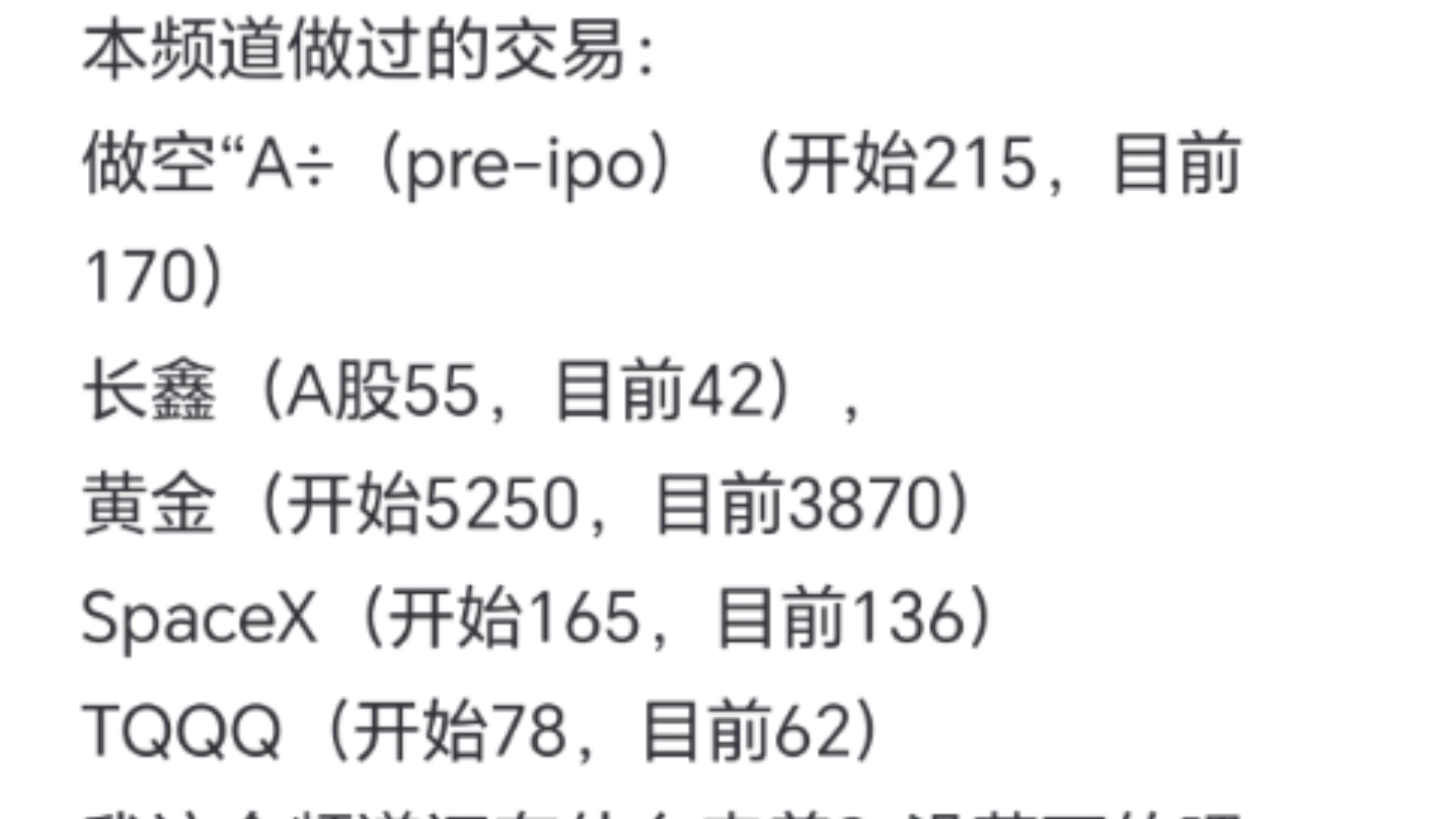
After posting the trade at Point A, I lost with five trades. So I'm going to re-do an episode on this account, and while I'm at it, go over the expectations for all the trades I've made before. First, let me clarify something: you'll notice that all the trades I've made on this account are short positions, and people call me some kind of "big bear." That's actually not the case.
The main reason is my current expectation for the entire market—whether it's A-shares, US stocks, gold, or many other commodities—my overall outlook is bearish. I'm broadly pessimistic about all of them. But I haven't always been this pessimistic.
In 2023 through 2025 I was bullish. It's just that now, after the liquidity expansion, all assets have been inflated—these assets are in a bubble state. Most assets have been pumped up by the Fed's rate-cutting cycle, right?
Of course, that's just the big backdrop; there are other reasons too, but broadly speaking that's the situation, including the AI bubble. Back in 2023–2025 I was bullish, and now I've turned bearish, which means I have some expectation of liquidity tightening. I genuinely do think they're all too expensive.
OK, now let's get back to Point A's prospectus. Actually, I think Point A has now run into a big problem. When I first shorted Point A, it was at 2.15 trillion, and now the market cap expectation is only 1.7 trillion—the unit is US dollars.
Of course, I still think even that number is exaggerated. The reason is simple: looking at Point A's new prospectus, it's listing in November, and in theory it should have published its Q3 earnings guidance, but it didn't. I think that was deliberate—it intentionally did not publish Q3 guidance.
Why? Because the Q3 guidance would affect its IPO price. What does that tell us?
What the market cares about most right now is its growth, so its Q3 growth must have already slowed.
We can actually sense this problem from downstream. When I talked about the two markers of the AI bubble, the first was capital expenditure—the market no longer rewards capex. Increases in capital spending are now seen as a negative.
You can see the recent state of the market. The second is that core AI-bubble companies like Point A and OA are seeing growth slow down. With downstream capex already starting to contract, it's predictable that Point A's growth will slow too.
Under these circumstances, its failure to publish Q3 results is, I believe, an attempt to cover up its slowing revenue. But it will have to talk about it eventually. That means once Point A lists, I think the moment its growth slows, the whole AI bubble could be shaken by it.
In that situation, a 1.7 trillion market cap is unquestionably unsustainable. I think Point A will ultimately end up as a company worth only a few hundred billion dollars in market cap—a big decline. That's similar to my expectation for SpaceX.
Actually, my SpaceX view is unchanged—it's still the original expectation: below 80. It won't get there that fast; there have been some rebounds along the way. Musk has done a lot of things, like rumors of a merger with Tesla and so on.
None of that matters—a rebound is just a rebound. Just take profit below 80.
As for ChangXin, there's not much to say. I've already covered ChangXin on my main account. I expect its ending will be falling below its IPO price and then grinding down for many years—breaking issue means going from over eight yuan to single digits, falling even further.
As for gold, there's not much to say either. My original target was 3,400 by year-end, and I'm still taking profit at 3,400. It's at 3,870 now with two months left until year-end, so it's a bit of a stretch.
But with my gold position, I don't really recommend focusing on price—it doesn't fluctuate that much anyway. You just need to prioritize watching the funding rate. The funding rate is very important.
In fact, most of the profit in gold comes from the funding rate, not from shorting the nominal price—that's just how it is.
TQQQ has even less to say about. It won't let me talk about it either—whenever I post, it gets taken down. But my overall view on the Nasdaq is bearish, and a fairly long-term bearish one.
I think the Nasdaq could grind down for about two years—after peaking, it needs to grind down for roughly two years before truly bottoming. There may be multiple rebounds along the way, even one- or two-month rallies, but in the end the index should be cut in half—that is, dropping to the 10,000s. Haha, that's my expectation for the Nasdaq.
And that's all the expectations for this channel—just a quick review of the previous ones. Overall, all the views I currently hold have been playing out. That doesn't mean I'm some genius—I wouldn't claim that.
The main issue is that there's one big direction, and they're all shorts, all leaning bearish. Whether A-shares or US stocks, the recent period has been broadly bearish, plus gold. Everything is in a state of liquidity contraction, so they're all leaning bearish.
It's not that I'm so brilliant—it's just a judgment of the big direction, a judgment of the big trend.
And that's the end of today's video. I'm currently devoting more of my energy to looking for long opportunities—though when I say long opportunities, I really mean hogs. Whether hog futures or hog stocks, that's where most of my attention is now.
A large portion of my positions is in hog stocks, with a small cash reserve set aside for opportunities in hog options and futures. But that opportunity hasn't arrived yet. That's where my focus is right now.
If there are new expectations for overseas markets, I'll still post them on this account, but most of my energy is on hogs these days, and I haven't been paying much attention to overseas markets. Haha, that's roughly the situation. That's about it.