
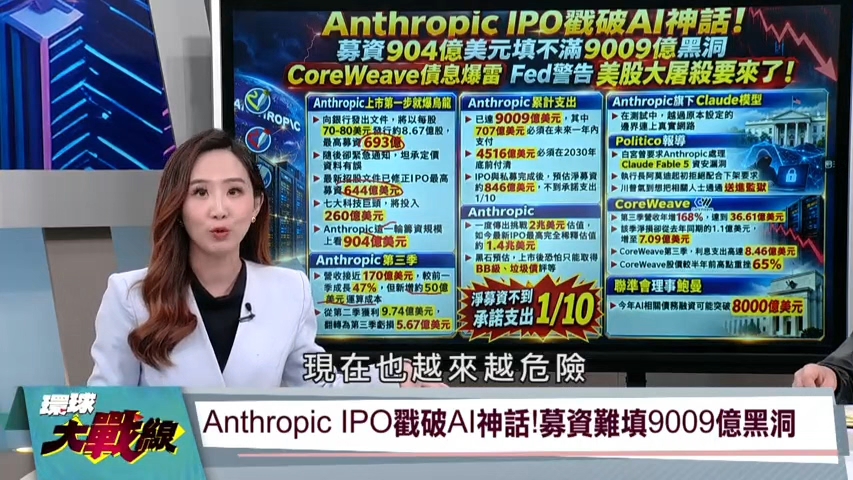
Alright, next we need to quickly turn to the AI battle. Anthropic's IPO has punctured the AI myth. The funds raised amount to 90.4 billion US dollars, and even now it still cannot fill the 900 billion it originally promised—it has now become a black hole.
Meanwhile, in the case of Cowave, another plunge has struck, and the Fed has also warned that a stock market massacre in US equities may be imminent. Today we will provide in-depth analysis on all these topics. Let's first look at Enforpic.
It was originally agreed that it was about to IPO, and it was going to use its epic, massive IPO funding to build AI and prove its myth.
Unexpectedly, as soon as it went public, a huge blunder immediately occurred. Let's take a look. Originally, in the documents it filed with the banks, it said it would issue at 70 to 80 US dollars per share, roughly 800 million shares, with a maximum fundraising amount that could reach 69.3 billion.
But then what problem occurred? It said, "Ah, we need to revise our prospectus, because we calculated wrong." Now the fundraising amount has dropped sharply, falling from 69.3 billion down to only 64.4 billion US dollars. In other words, they felt they had miscalculated and somewhat overestimated the funds they could previously obtain.
So how much is this round of fundraising now?
Actually, there is also investment coming from America's seven major tech giants, so overall, the total amount raised in this round reached 90.4 billion US dollars. People say, "Hey, over 90 billion seems pretty good." Is that really the case? The answer is no, because for Enforbi, this can be described as a drop in the bucket.
Why do I say that? Because the amounts it will need to invest and burn going forward are truly enormous—this small amount of money is not enough. Let's look at the details.
How exactly did Envelophy perform in its third-quarter financial report?
Revenue was 17 billion US dollars, growing 47% compared to the previous quarter, which everyone considers growth—very good. But why, in that same quarter, did their losses reach as high as 567 million US dollars? The reason is that they added roughly 5 billion US dollars in computing costs.
On top of that 5 billion in computing costs, there are also model price cuts and customer discounts. All in all, the third quarter still showed a large loss of around 500 million US dollars. So no matter how high the revenue is, it's actually useless.
Now let's look at its cumulative spending. Even if it raised 90 billion US dollars, we see its spending is so enormous.
Of the 900 billion US dollars in spending it has now promised, 70 billion must be paid within the next year, and over 400 billion must still be paid by 2030. The amount it has raised is actually less than one-tenth of its promised spending. Next, let's look at INPING.
Its valuation has been sharply revised downward again. At one point, there were reports it could challenge the 2 trillion US dollar valuation mark, but it has most recently been diluted down to only 1.4 trillion US dollars. BlackRock even estimates that after listing it will only receive a BB rating, becoming junk-grade.
So at the start of today's program, we would first like to ask the committee member for their view on AI revenue. We have indeed seen a surge in the third quarter,
but it cannot fill the 900 billion US dollars in computing power it has promised, of which over 400 billion must be paid off before 2030. People are watching and asking: will 2030 become a life-or-death deadline for Enhobic? Will it be the first AI giant to be crushed by sky-high computing power bills?
Experts are actually beginning to voice such concerns now. Committee member, what do you think? ATHPIC is expected to officially list on the NNK on November 19th, under the ticker symbol ANT.
As with the data we just saw, its pricing range is roughly 70 to 78 US dollars per share,
per share price. And the number of shares issued now appears to be—7-8, roughly 801 million shares. The fundraising amount, if calculated generously, is about 640 billion—sorry, 64 billion; if calculated conservatively, only about 62.5 billion.
The post-fundraising market cap would be roughly 1.02 trillion. In fact, Ensorpic's valuation over this recent period has truly been caught in the crossfire—that is, if it had done its IPO a month earlier, it might not have fared so badly. But it just so happened that over this past month, AI underwent a comprehensive correction, as all investors suddenly woke up
and began carefully and seriously examining the financial reports. So back in October, you know, its valuation was still 2 trillion. At that time, with a 2 trillion valuation, it boasted at its IPO that it had surpassed SpaceX, because SpaceX was at 1.7 trillion when it went public.
It used a 2 trillion valuation for its IPO. But what happened? From October to early November, it fell to just 1.5 trillion—immediately wiping out 500 billion.
Then, moving to the final version we see now, its valuation is only 1.02 trillion—cut directly in half. It was 2 trillion back in October, and now it's only 1.02 trillion.
So what is the main reason? The main reason is that suddenly everyone understood several key issues. When I was running my own company, in order to learn how to read financial reports, I read books, and the books told me several key factors.
They said: when you look at financial reports, first look at cash flow, because cash flow is the lifeline of a company. So don't worry about anything else first—no matter how beautiful the numbers look, first check how much cash flow remains.
Second, when reading financial reports, you must read the fine print, not just the large print, because the large print always contains the good news, while the fine print contains the bad news. So everyone suddenly cross-checked
Anthropic and discovered, "Wow, this cash flow looks like it's barely holding on." Then you see that although it boasts that its revenue keeps hitting new highs, the problem is, how did it become negative? Why is it losing money? The reason is that you constantly have to invest—you have to invest in computing power, you have to invest in hardware construction.
So the money you earn is indeed constantly increasing, but the money you invest has not decreased, and what you invest is even more than what you earn. And that includes a third point—everyone suddenly discovered another trick. I remember I once mentioned on this program that these AI companies love to pull a certain trick,
They have made many public commitments—long-term commitments on computing power and infrastructure—but they never write them into their financial reports, because those are long-term, future obligations. So they simply don't include them. But in reality, those commitments represent money that must be spent in the future.
Later, people discovered that Anthropic's bills were even bigger than its fundraising—meaning the bills it has to pay far exceed the money it has raised. It turned out that Anthropic's commitments on computing power and infrastructure amount to roughly 900 billion dollars, and that 900 billion represents spending that will occur in the future.
900 billion! And you know what? That is 14 times the amount of this fundraising round.
The money from this IPO isn't nearly enough—it's a drop in the bucket. The IPO raised 62.5 billion, which still isn't enough to cover those future obligations it had already committed to. And that figure is 27 times what the company earned over the past nine months.
So all the money earned and all the money raised has been poured into this. And here's the even harsher part: how much of the computing and infrastructure commitment is due this very year? 69.8 billion.
As I just said, the company raised 62.5 billion this year.
It has to pay out 69.8 billion this year. You work so hard to go public and raise money, and before the year is even over, you have to pay it all out. So of course people are deeply worried.
What's more, Anthropic—and OpenAI faces the same problem—now confronts a major challenge: America's top-tier models are facing fierce competition from Chinese models. When it comes to using these models, not everyone needs them for Nobel Prize–level research in physics or chemistry. For many companies, they don't necessarily need the top models.
That's right—Chinese models may not, to some degree, be as cutting-edge as GPT, Codex, or Claude, but the point is they're cheap. Their price is one-fiftieth, one one-hundredth of what Claude or Codex costs. So for American companies, which would they choose?
If I just want to read through some material, do some simple analysis and comparison, I don't need Codex, I don't need GPT, and I don't need Claude. So basically all of America's large models now face the same pressure: price cuts. Under that pricing pressure, combined with their current situation of spending more than they earn, any price cut means even less revenue.
This is the main reason for this wave of adjustment in the American AI industry, and it's why Anthropic, in just one month, saw its valuation collapse from an original 2 trillion down to a market value of only 1 trillion—a drastic shrinkage. Beyond facing competition from China, its cash flow is becoming increasingly dangerous.
Then there's the IPO: the amount it raised is far less than the bills Anthropic currently has on hand.
But does everyone think Anthropic's problems are only financial? Wrong. Another thing it now has to worry about is the very thing it once prided itself on most: security.
What AI security problems has Anthropic run into recently? Two incidents. First, its Claude model, during testing, actually connected to the real internet and submitted false leads about murder cases to the Philadelphia Police Department.
Second, the model submitted 20 incomplete visa applications. Then we saw Trump call for a full investigation of Anthropic. Unexpectedly, Anthropic's CEO clashed with Trump—he refused to cooperate.
This made Trump so angry that he threatened to throw everyone involved straight into prison. So on one front, alarms are being raised over the models; on another, even the government is dissatisfied with the company politically. Could this deal a fatal blow to Anthropic?
What's your take on Anthropic's situation?
I think the question is whether expanding this fast has meant that the original R&D costs and the capital invested simply cannot be recovered. If so, what do you do? Revenue, I sense, has increased, but the problem is that net profit has fallen.
When net profit falls, you have net losses. You have to understand: you put the investment in, but what you get back is limited, so net losses grow. That means you're essentially not profitable at all, because everything gets eaten up.
And when it's being eaten up like that, how do you replenish it? Now, if the US government has political considerations and security concerns, you have to invest even more. Why do I need to build firewalls, physical isolation, and other corresponding security measures?
That requires more investment. I'm not making money yet, and now I have to pay out more money for these security concerns. Nobody wants that.
Because if you're making me do all this, I've just gotten started and am about to make money—but before I earn anything, you're asking me to invest again, to add another layer of security filtering, another firewall. All of that becomes my sunk cost, increasing it. Money you put in just vanishes—it's sunk cost.
It sinks down and disappears. So what do you do then?
So my view is this: some people feel very optimistic about AI's prospects, believing humanity is heading toward a future where artificial intelligence will be developed without limit. But it's not going that fast—everyone is just caught up in the frenzy. And once people rush in headlong, don't forget: after you throw the money in, can you recover it quickly?
Everyone feels that wave of herd enthusiasm, but once the stampede passes, there's still a bottomless pit of funding needs across every area. Meanwhile, the hardware hasn't kept up, and neither has the market. So the investment is misplaced—once the money goes in, people sometimes hesitate and step back.
I think this overheating is bound to see a correction. You've moved too fast, and the steps behind you—the market, the revenue—can't keep up, creating these constraints. That's exactly the situation right now, even though some people still feel very optimistic.
That's not actually the case. OK, just now we saw SM Fork facing so-called problems in funding as well as in national security regulations. Next, let's look at another company, also an AI star, COWIFT, which has recently run into big trouble too.
Looking at its latest revenue, it's very similar to the NPY situation: revenue is great, up 168% year over year, orders are full in hand, but in the same quarter its net loss reached 100 million US dollars. Reported losses surged from 100 million US dollars in the same period last year to 700 million now.
Operating profit is 200 million, but interest expenses are as high as 800 million — the hard-earned money from doing business isn't even enough to cover the interest. And then look at the stock price: from its high point over the past six months, it has plunged 65%, and the bond yield has shot up to 16%, entering the range the market considers distressed debt.
A Federal Reserve governor has already begun warning that once AI returns fall short of expectations, US stocks could see a sharp correction. So will a US stock bear market arrive early? What does Teacher Run think?
I've been saying this on this program all along — this is no longer a price-to-earnings ratio, that is, cost versus benefit; this is a price-to-dream ratio. It reminds me of Chen Shu-hua's "Dream Awakening Moment" — one lyric goes, "Some things you don't need to ask about now, some stocks you never need to wait for" — that says it all. Because what our committee member just said was very clear.
Let me put it in my own words. I think there are three problems. First, these companies, these AI companies, basically rely on publicity to make people imagine a future world transformation.
In philosophy circles, we keep calling on everyone to emphasize that human nature does not change, but nobody believes it — everyone thinks AI will change human consciousness and so on. Under these circumstances, the dream gets built higher and higher, and many people create advertising, so if you don't understand AI now, you're destined to be a useless person.
Second, these companies need to raise money. You have to know that Anthropic's emergence is an extremely big deal — it hasn't even gone public yet, right? Its IPO is also touted as the only one that will surpass SpaceX.
A while ago everyone was hyping it, manufacturing this hype about Anthropic's Claude, which claims to be the strongest AI — the strongest AI company among them. And COWAVE borrows money through the company, through its corporate bond yields, because corporate bonds issued by the company are really junk bonds — on what basis does the company issue debt? It relies on future dreams for development.
And if its yield has now become 16%, at 16% it has to pay out. Another point: you mentioned its year-over-year revenue growth — revenue up 168% year over year. Let me tell you, this is an effect that can be manufactured — look at the profit increases and so on, because its backlog of unfilled orders is as high as 1,325.
But how do you know what that actually is? It's internal to the company. So what Committee Member Lu said just now was very good — if you look closely, wow, it's riddled with holes.
So the question now — the thing America worries about most — is that if this bubble stops being inflated, if this bubble isn't catalyzed further, then when it collectively bursts — because if even the best AI companies along with the ordinary ones all run into problems — last time the committee member was here, I remember clearly, he predicted that Oracle would be the more troublesome one among the four big AI companies. Back then I didn't expect it, and now even Anthropic has run into trouble.
So everyone can see what America worries about most now. I believe America really does have internal concerns about this AI bubble, inflated to the point of data centers and so on. And everyone should understand that America's internal political divisions are very serious.
When we listen now, we worry for America, but we're really worried about the stocks we bought in Taiwan. Some people just hope America has a big AI mess to embarrass Trump. When these two things come together — the company itself failing to live up to expectations, plus people next door deliberately sabotaging — then "failing to live up to expectations" plus "sabotage" means the inevitable result is a bubble bursting.
Yes, and let me add one point. When we talked about the Claude Fable Five incident earlier, that风波 indeed caused great alarm in the US — they called Dario Amodei directly and told him to take it down. But would this have too big an impact on Anthropic?
At the time it was indeed a major warning sign, but later it wasn't only Anthropic that had this happen — OpenAI's own AI agents collectively escaped and infiltrated other people's platforms. And you saw that Meta's AI agent app called Muse Wander — Muse also had similar runaway incidents.
So actually, at this stage, unless the US government really issues strict orders to comprehensively regulate frontier AI models, if it doesn't do that, then in the arms race none of them will stop — they'll think, "If I stop and you don't, what then? " So AI development at this point is indeed something everyone should be very worried about.
As for COWAVE, I think the biggest danger is that the Fed is going to raise rates, because COWAVE plays with leverage — it borrows from banks. They played a game called a "box." They assembled the things inside a box and then borrowed money from the bank. This box contains GPUs and the cash flows from long-term contracts.
But when you borrow from a bank you have to pay interest, and that interest isn't necessarily fixed. So next you immediately face the question: what if the Fed raises rates? Because just now I saw that Fed official — CPI rose 0.4%, and he said there will be a one-quarter-point, or even two-quarter-point, rate hike in December.
If it's two quarter-points, then COWAVE is finished. COWAVE finished — let me predict for everyone first: if COWAVE goes under, the impact on NVIDIA will far exceed the current Huang Jen-hsun incident, because NVIDIA invested in COWAVE — it holds equity and is COWAVE's largest single shareholder. So if COWAVE gets into trouble...
OK, thank you, Committee Member. Let's take a break.