
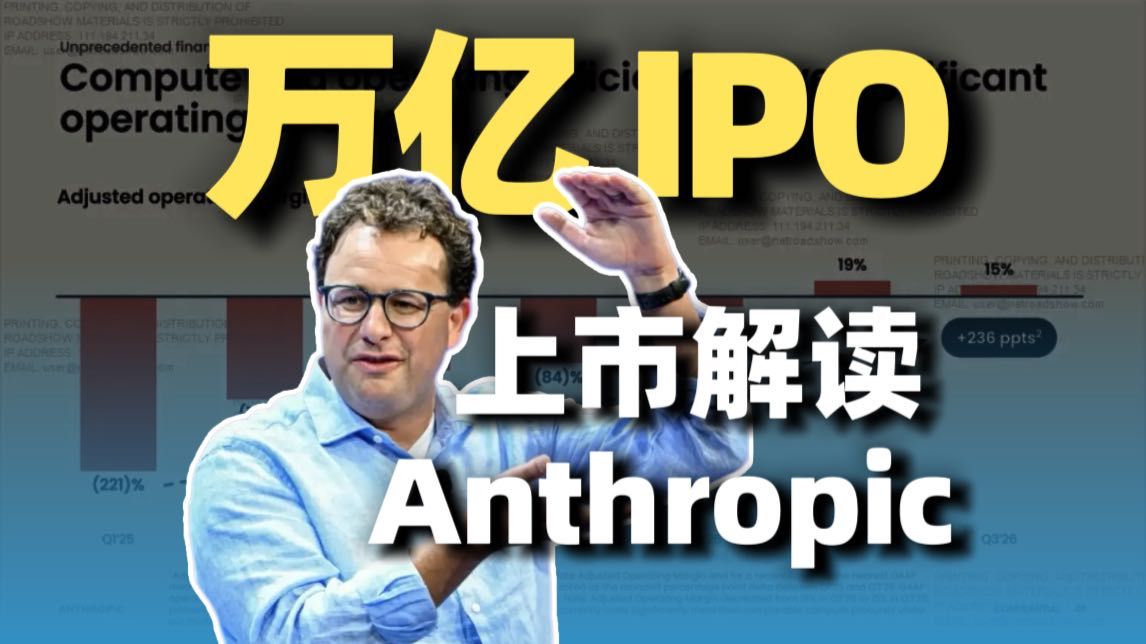
Anthropic's 57-page IPO roadshow deck is here. Why is it possible for the company to challenge the record for the largest IPO fundraising in history set by SpaceX? Both are top-tier global large-model companies, so why did Anthropic choose to pursue an IPO while OpenAI chose to continue with private financing? What exactly are the differences between these two giants' business models? Which one is the real money-printing machine of the AI era?
Keep in mind that Anthropic was only spun out of OpenAI in 2021. Dario led a group of core researchers to leave because, at the time, they felt Sam Altman was pushing commercialization too fast and neglecting AI safety. Anthropic champions "constitutional AI," focusing on controllability, safety, and fewer hallucinations. That departure back then has now reached the middle game in the capital markets.
This offering is 825 million Class A shares, priced in a range of 70 to 78 dollars. Combined with concurrent private placements and the over-allotment option, the total financing scale exceeds SpaceX's previous record. Here you must be careful to distinguish the figures: 1.02 trillion is the market capitalization upon completion of the offering, while 1.4 trillion is the target valuation on a fully diluted basis.
In Q3 2026, quarterly revenue was 16.956 billion dollars, up 46.7% quarter over quarter. By the end of October, the annualized run-rate revenue (ARR) had surpassed 81 billion dollars. But the company carries huge book losses.
The prospectus states that by 2030, the total value of signed compute infrastructure procurement contracts approaches 900 billion dollars, and many of the clauses are take-or-pay obligations—even if the compute sits idle, the money still has to be paid.
To make this easier to understand, let's start with a somewhat loose analogy. If we compare the large-model industry to city construction, ChatGPT is more like a top-tier salesperson with high emotional intelligence and great verbal skills—excellent at chatting, but occasionally making things up off the cuff, which is what we call hallucination.
Claude is different: it's more like a rigorous senior structural engineer, highly stable in long-document processing, multi-step logical reasoning, and code generation, with better hallucination control. In particular, Claude Code has captured more than half of the enterprise AI coding market.
But in terms of business model, the two have completely diverged. OpenAI leans toward selling gym memberships—C-end subscriptions at 20 dollars a month. After signing up, users might call the API frantically every day, or not use it at all for a whole month, making the marginal cost of compute very hard to control, and the pool of free users keeps consuming massive amounts of compute.
Anthropic, by contrast, sells water meters and electricity meters: 70% to 80% of its revenue comes from enterprise APIs, settled by token usage. Enterprises use it to run automated workflows, review legal contracts, and refactor code—however much the "meter" runs, that's what the bill settles. Revenue is directly tied to compute consumption, so the unit economics are much cleaner.
This reminds me of two similar cases. The first is Cisco at the peak of the dot-com bubble in 1999. Back then, telecom giants frantically signed tens of billions of dollars in long take-or-pay contracts for fiber-optic routers, but demand ultimately couldn't keep up, and those long contracts became a heavy burden.
Applied to today, Anthropic's nearly 900-billion-dollar long-term compute contracts follow exactly the same logic. If chip inference costs fall rapidly, or if downstream enterprises' AI budgets shrink, these rigid payment obligations will become a boulder pressing down on the balance sheet.
The second is the comparison between Facebook's listing in 2012 and Google's in 2004. Facebook's IPO was essentially about providing an exit channel for early investors and employees, while Google, relying on the cash flow from search advertising, deliberately postponed its listing. Anthropic's current position is more like Facebook's back then.
Google and Amazon are both shareholders and its largest compute suppliers. One of the core purposes of the IPO is to complete asset securitization and create a liquidity exit channel for the cloud giants. OpenAI, on the other hand, prefers to stay private, avoiding the quarterly scrutiny of public-market financial reports so it can focus on its long-term bet on AGI.
So why is Anthropic going public now? I've seen many media interpretations claiming that Anthropic is rushing to go public because its huge book losses are becoming unsustainable.
But if you look carefully at the prospectus, you'll find the truth: most of the so-called massive losses come from accounting fair-value changes on convertible bonds and SAFE agreements—paper numbers produced by the surge in valuation, not real money actually spent. In Q2, the company even recorded 974 million dollars in non-GAAP operating profit.
Its real money-making capability on the B-end is far stronger than people imagine.
Some also interpret the IPO as cashing out at the peak because the technology has hit a ceiling. That's not the case—RSI and AGI are still far from arriving. In my view, the core reason is to move the cloud giants' compute spending off-balance-sheet—that is, to refinance the massive compute capital expenditures through the public market.
So why is Anthropic rushing to go public while OpenAI is not? The root cause lies in differences in governance structure and funding needs. Anthropic has been a public benefit corporation since its founding, with clear rules on equity and control.
OpenAI transitioned from a nonprofit to a commercial entity, so its structure is more complicated, and its Stargate project requires sustained investments of hundreds of billions of dollars—it doesn't want to be constrained by the short-term profit demands of the secondary market.
Anthropic's ability to reach a trillion-dollar valuation is not primarily due to its base models themselves, but rather agent tools like Claude Code, which have generated verifiable, scalable paid revenue. When this signal reaches China, it means capital preferences will also accelerate their shift.
In the past, people were still willing to pay for parameter benchmark rankings of general-purpose large models; going forward, capital will be pickier, prioritizing agent applications that can close the loop rather than simply stacking up base models. So entrepreneurs should stop blindly burning money on general-purpose base models.
Anthropic has already proven that high-value commercial increments come from agent automation—workflows, code, legal compliance—these long-text, strong-logic scenarios are naturally suited to usage-based billing. This is also where China has the best chance of achieving differentiation.
For business judgment, the key is to see whether agents can consistently help clients replace work hours, cut costs, and improve efficiency. You also need to distinguish which revenues are inflated by related-party compute transactions and which are genuine payments driven by real business demand.
The divergence in the two giants' routes is essentially a divergence in billing leverage, inference marginal costs, and customer structure. Anthropic has a long-context premium mechanism as well as prompt caching discounts—up to 90% off—to lock in enterprises with high-frequency reuse of system prompts.
Customer payments are mainly prepaid, so cash flow is very healthy. OpenAI, meanwhile, runs a multi-tier model matrix: low-priced small models capture large volumes of simple tasks, and the subscription billing model fits better with traditional large enterprises' procurement processes.
On the compute ledger, OpenAI is deeply tied to Microsoft Azure, but it has to bear the massive inference costs of hundreds of millions of free users. Anthropic uses a multi-cloud strategy, binding itself to both AWS and Google Cloud to diversify supply chain risk, but it has to accept revenue sharing on compute, plus that enormous, hard-to-pay cloud bill.
On one side is an industrial-grade API business with high customer value and high retention; on the other is a traffic gateway with a massive user base. There is no absolute right or wrong in business—these are simply two completely different paths to monetizing AI. And this IPO is essentially setting a pricing benchmark for AI agent commercialization worldwide.
The entire B2B agent commercialization framework we discussed today—usage-based billing and agents reshaping industry revenue models—is fully broken down in my new book, "The Agent Economy." It covers how agents restructure corporate cost structures and revenue models, as well as the valuation logic and risk boundaries of this track. If you're interested, feel free to check it out. I'm Du Yu, helping you understand the past and future of the AI track. Hit follow, and see you next time.