
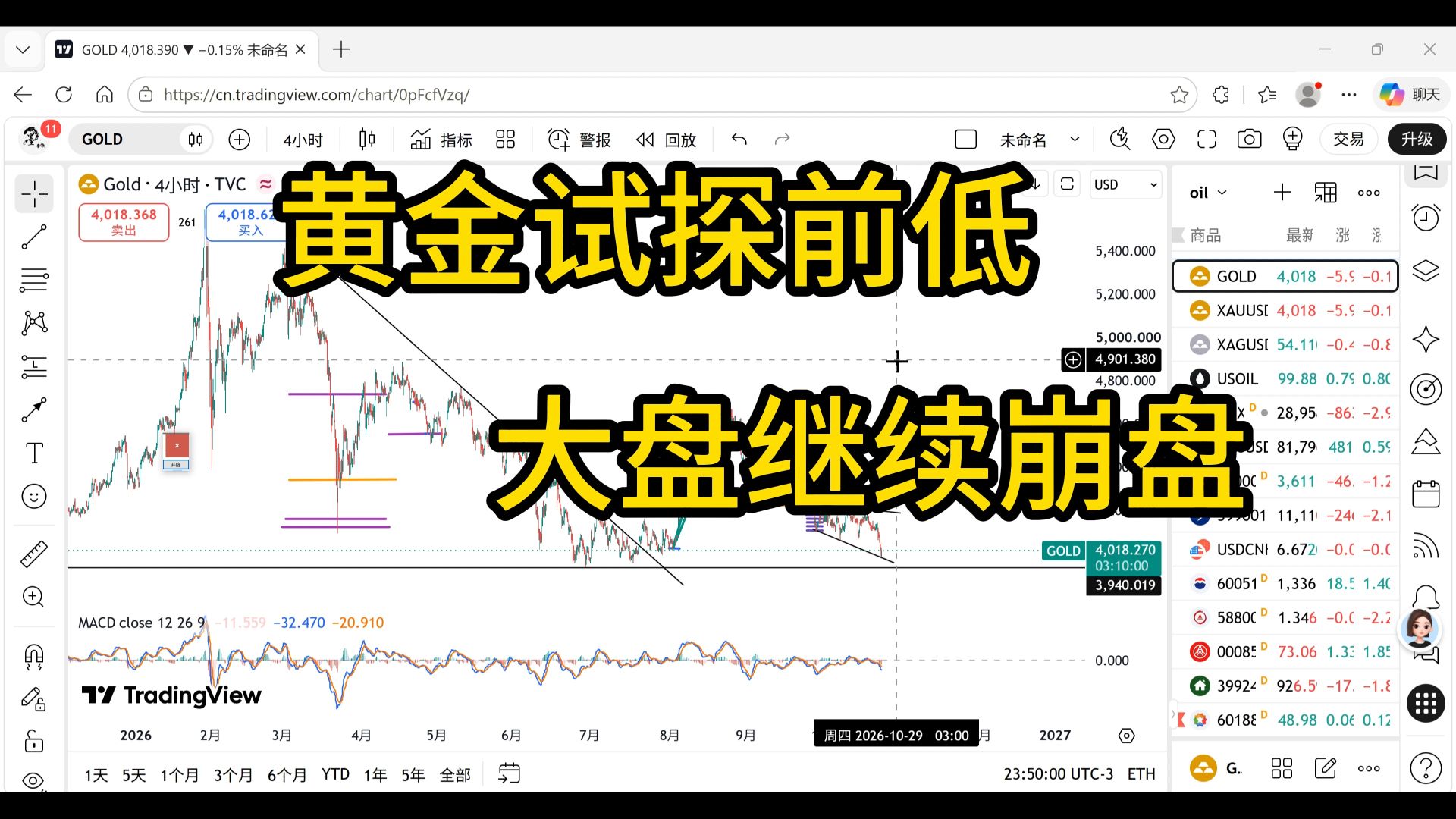
Hello everyone, take care. In this episode, let's talk again about the gold market. Last time I told you that gold, trading between 4000 and 4200, was at the end of its consolidation and about to choose a direction—and in the end, it chose to go down.
Having chosen to move downward, it should head straight toward the previous low, and may even break below it. Today it has indeed dropped to around 3900.
So what should we watch going forward? What we need to watch is what happens above the previous low. For example, right now it is still in a pattern of lower highs, and compared with the earlier move, it is still in an accelerating state.
Whether it can turn into a weakening state is very important. In other words, if you want a decline to end, either there is a vertical plunge followed by a violent reversal, or after the fast drop it turns into a slow decline. So what to watch going forward is this: for example, today it rebounded all day, oscillating in this range.
After a full day of rebound, the next leg down may be the decline that is very close to the final leg in the near term.
The key level to watch is the low at 3940. This round of decline may still be a shakeout move after breaking below that level—or even without breaking it, the shakeout purpose may already have been achieved. Because this kind of price action is actually fairly common over gold's long-term cycles.
For example, from 2020 to the end of 2021, after a prolonged decline ended, there was a rebound that failed to exceed the previous high, followed by a deep pullback to a low almost level with the prior low. It was certainly after that round of decline that many people turned pessimistic and exited their positions, only for a rally to follow.
For now, let's not worry about whether it breaks through or not—we are still at this stage. This is also why I previously treated it as a right-side setup. Because for an uptrend, the right side of a pullback—for example, a retracement of 50%, or a deeper one of 80%—only in such extreme cases as a 99% retracement is the probability very low. So at 50% or 80%, the conditions for buying are already met. That's how to understand it from the perspective of retracement depth.
Do not treat a retracement all the way back to the starting point as a normal phenomenon. What does a normal situation look like? For example, like this segment here—relative to the previous low, it stays fairly far away, right?
Relative to the previous low, it stays fairly far away. Anything below 50%, and 80% is already a very deep price. A move that rises and then retraces all the way back to the bottom is a very rare occurrence.
So even though we've encountered it this time, never adopt that kind of thinking in the future. Don't keep assuming that whatever the market gains it must give back—this is something to be mindful of. Because it can easily create an impression when you're in a pessimistic mood: that this asset will just be like this from now on.
And when you trade it, you will...