
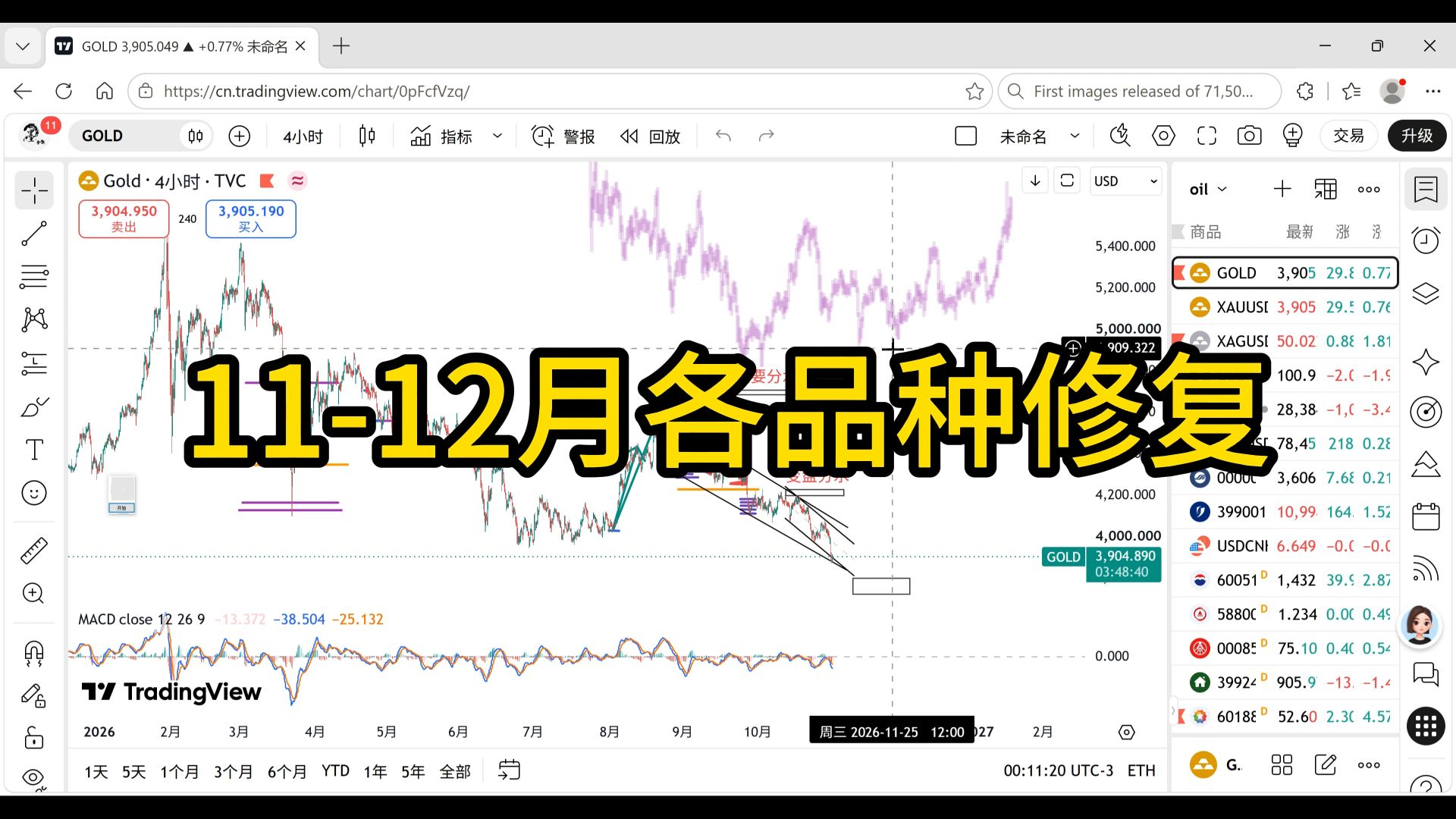
[00:00:00] Hello everyone, I'm Baocun Mo. [00:00:01] The midterm elections are coming up very quickly this week. [00:00:06] Before that, gold broke down early, and after the break it fell another few dozen points. [00:00:12] Although the drop wasn't much, it has already disrupted the original plan, right? The original plan was a six-month decline, followed by consolidation and then a continued rise. [00:00:20] Now the timeline is longer and the depth is deeper, so that plan has failed for the time being. [00:00:24] After the failure, [00:00:25] because the position was bought at 15 with no leverage, [00:00:27] it can still be held. [00:00:31] This is different from what many of you are thinking. [00:00:32] What you're thinking is: [00:00:33] since it has broken below the dividing line, [00:00:34] the consolidation might last longer, [00:00:35] the waiting time might be longer, [00:00:36] so why not just cut losses, [00:00:38] or something like that? [00:00:39] But my view remains the same: [00:00:40] the purpose of buying it is as part of asset allocation. [00:00:44] Of course it's speculation— [00:00:47] it's definitely about making money— [00:00:48] but after all, it's gold, [00:00:50] right? [00:00:51] Even if it takes one or two years, [00:00:52] it will come back. [00:00:53] So what should we focus on now? [00:00:55] The point of focus is: [00:00:56] since this trend has failed for now, [00:00:58] what kind of process will it go through? [00:01:01] The six-month scenario [00:01:04] is now off the table, [00:01:06] so it will move into a two-year or four-year cycle. [00:01:10] I've mentioned this before— [00:01:12] when I took this position, [00:01:13] I had already talked about it many times, [00:01:14] namely the three possible timeframes overall: [00:01:18] one is a six-month correction followed immediately by a rise; [00:01:20] one might drag on for two years; [00:01:21] and another might drag on for four years. [00:01:23] Why do I say this? [00:01:24] Because you can see on the weekly or monthly charts that, [00:01:26] over roughly the past 20 years, [00:01:29] gold's pattern has been: after one big rally, [00:01:32] a correction lasting nearly four years, [00:01:34] and then a super rally. [00:01:38] Right? [00:01:39] And in between there were these two-year corrections. [00:01:41] Now it's in a correction. [00:01:44] Since it doesn't belong to the smaller-scale [00:01:46] six-month type of correction, [00:01:48] we should expect it to adjust over a two-year period. [00:01:50] But in that case, [00:01:53] how should we handle it? [00:01:55] It still comes down to price. [00:01:58] Right now there are two possible paths. [00:02:00] One is to continue something similar to the previous two-year consolidation, [00:02:03] or four-year consolidation. [00:02:07] That process is a decline, [00:02:11] then a rebound to a lower high, then another decline, [00:02:13] possibly returning all the way back to the starting point. [00:02:15] Right? [00:02:16] That's what its performance over the past 20 years looks like— [00:02:19] something like that. [00:02:20] So now that it has dropped, [00:02:22] it doesn't mean it will slide all the way down, [00:02:24] like the drop to 2,000 some people talk about. [00:02:25] You could say a dip might reach 3,736, [00:02:31] but what follows would be a rebound. [00:02:34] It just may not be able to make a new high anymore. [00:02:36] Once the probability of a new high decreases, [00:02:38] it may just consolidate again, [00:02:40] dragging on for two years or four years overall. [00:02:42] If it drags on for two years, [00:02:45] it might look similar to the earlier pattern: [00:02:48] decline, rebound, decline, rebound— [00:02:55] and right now we may be at this stage, [00:02:57] after which a long period of...
2026 Gold and Silver Prices · Original Bilibili video & transcript
Year-End November–December Expected to Be a Recovery Period for Various Assets: Watch Gold, Keep an Eye on Silver
Quick Summary
In this episode, blogger Bao Cun Mo (BOSS Mo) shares his personal judgment on gold's trajectory: gold broke down early ahead of the midterm elections and fell several dozen more points, disrupting his original plan of "continuing to rise after a six-month decline." Since he bought 15 jin (about 7.5 kg) of unleveraged physical gold as an asset allocation, he chose to keep holding rather than cut his losses. He proposes that gold historically has three types of correction cycles: six months, two years, or four years, based on the pattern on weekly/monthly charts over the past 20 years of "a major rally followed by a long correction and then another major rally"; since the six-month correction has failed, he expects the market may enter a two-year or even four-year oscillating correction. He stresses that a decline does not mean a continuous slide — the price could dip (he mentions a possible drop to 3,736) and then rebound but struggle to break to new highs, followed by further oscillation. All of the above are the author's personal views and speculation, not verified facts.
Video transcript
Text from the original video by @BOSS墨. Automatic recognition may contain errors; refer to the video.