
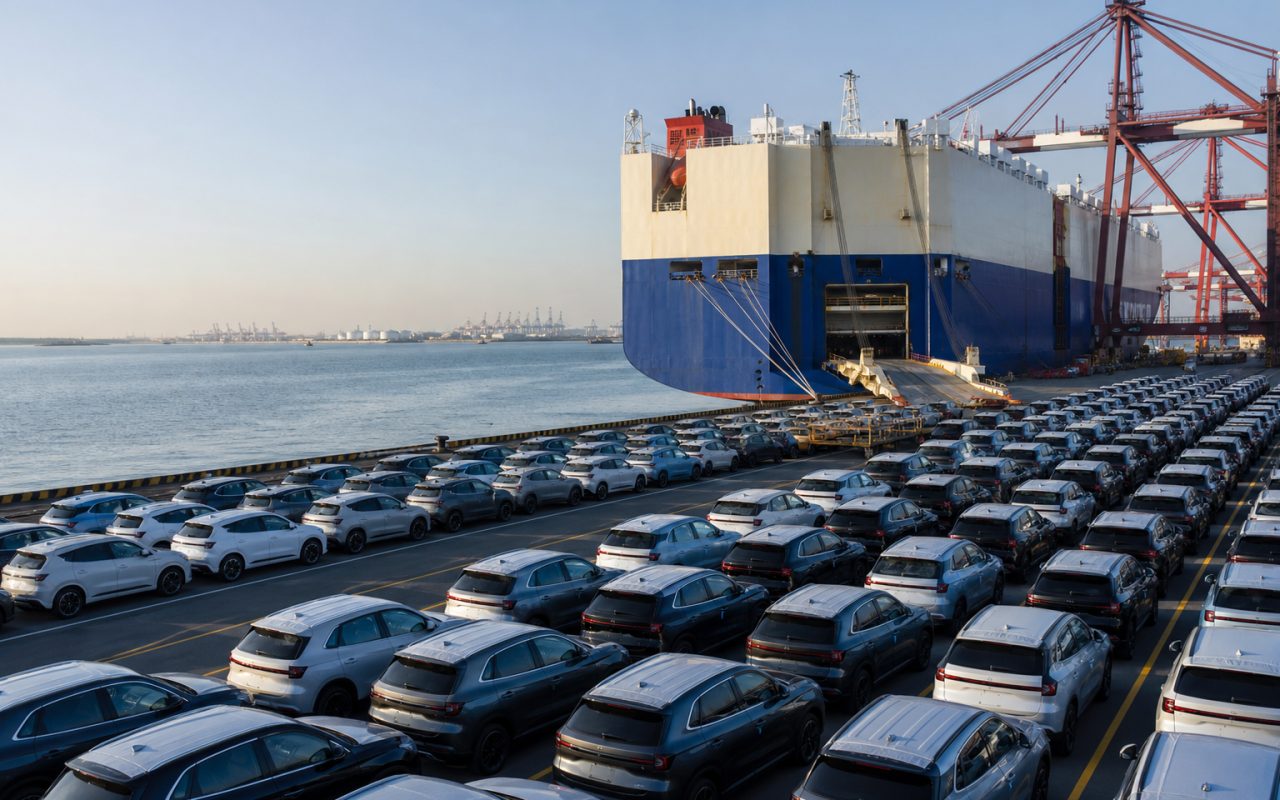
China exported 1.043 million vehicles in July 2026, including 553,000 new-energy vehicles.[C1] BYD alone exported 180,500 new-energy vehicles that month, equal to 43% of its total sales.[C5]
To see what that volume means for earnings, I compared the 2025 filings of BYD, SAIC, Tesla and Volkswagen. The gap is wide. BYD is likely already making money overseas. SAIC's public figures do not establish the same conclusion. Export volume is increasingly concentrated, and so is the profit.
BYD's gross margin is already above Tesla's
BYD reported RMB 648.65 billion of revenue from automobiles and related products in 2025, with a gross margin of 20.49%. Tesla's automotive gross margin was 17.8%, while Volkswagen's automotive division was at roughly 14.4%.[C6][C9][C11] Product mixes and accounting definitions differ, but the comparison is still useful. A margin near 20% sits toward the stronger end of this international sample.
SAIC's vehicle business was far thinner, with a gross margin of only 4.30%.[C8] That leaves RMB 4.30 of gross profit for every RMB 100 of vehicle revenue before selling, administrative, research, financing and tax expenses. Overseas distribution, discounts and tariffs can absorb that margin quickly.
Regional disclosures point in the same direction. BYD reported a 19.46% gross margin outside China and 16.66% inside China. SAIC reported 12.88% in other regions and 10.82% in China.[C6][C8] These regional figures include businesses beyond complete vehicles, so they are directional rather than pure overseas car margins. They do show that overseas revenue is contributing positive gross profit at both companies.
What one vehicle leaves behind
BYD recorded RMB 541.92 billion of passenger-vehicle revenue on sales of 4.55 million vehicles in 2025. That works out to about RMB 119,000 of recognized revenue per vehicle. Applying the 20.49% automotive and related-products margin gives an estimated RMB 24,000 of gross profit per vehicle.[C6] Components and other related businesses are mixed into that margin, so the estimate is useful as an order of magnitude, not as the profit on a specific model.
Tesla reported $69.53 billion of automotive revenue and $12.36 billion of automotive gross profit on 1.64 million deliveries. The corresponding averages are about $42,500 of revenue and $7,600 of gross profit per vehicle.[C9][C10] These are manufacturer revenue figures, not retail sticker prices. BYD recognizes less revenue per vehicle but earns a higher gross-margin percentage. SAIC's consolidated vehicle revenue and its reported sales volume do not cover the same set of entities, so its per-vehicle profit cannot be calculated cleanly from the annual report.
Export prices are unlikely to surge
The average price of a vehicle exported from China fell to about $16,000 in 2025, from $18,000 in 2024 and $19,000 in 2023.[C4] The extra volume has not lifted the product mix. European tariffs make the economics more company-specific: the EU's additional rate is 17.0% for BYD and 35.3% for SAIC.[C7] A higher European retail price therefore does not guarantee a matching increase in gross profit.
My base case for the next year is an average export price of $16,000 to $17,000, with volume growing faster than price. Moving back above $18,000 would require a clear increase in the share of sales going to higher-priced markets such as Europe. If small cars and plug-in hybrids continue to supply most of the growth, the average is likely to remain close to $16,000.
For investors, export volume alone has become a weak proxy for overseas earnings. BYD probably is making money abroad and already carries a gross margin above Tesla and Volkswagen. SAIC's 4.30% vehicle margin leaves too little room to infer overseas net profit from public filings. The next split among Chinese exporters will show up in gross margin before it shows up in the headline shipment count.