
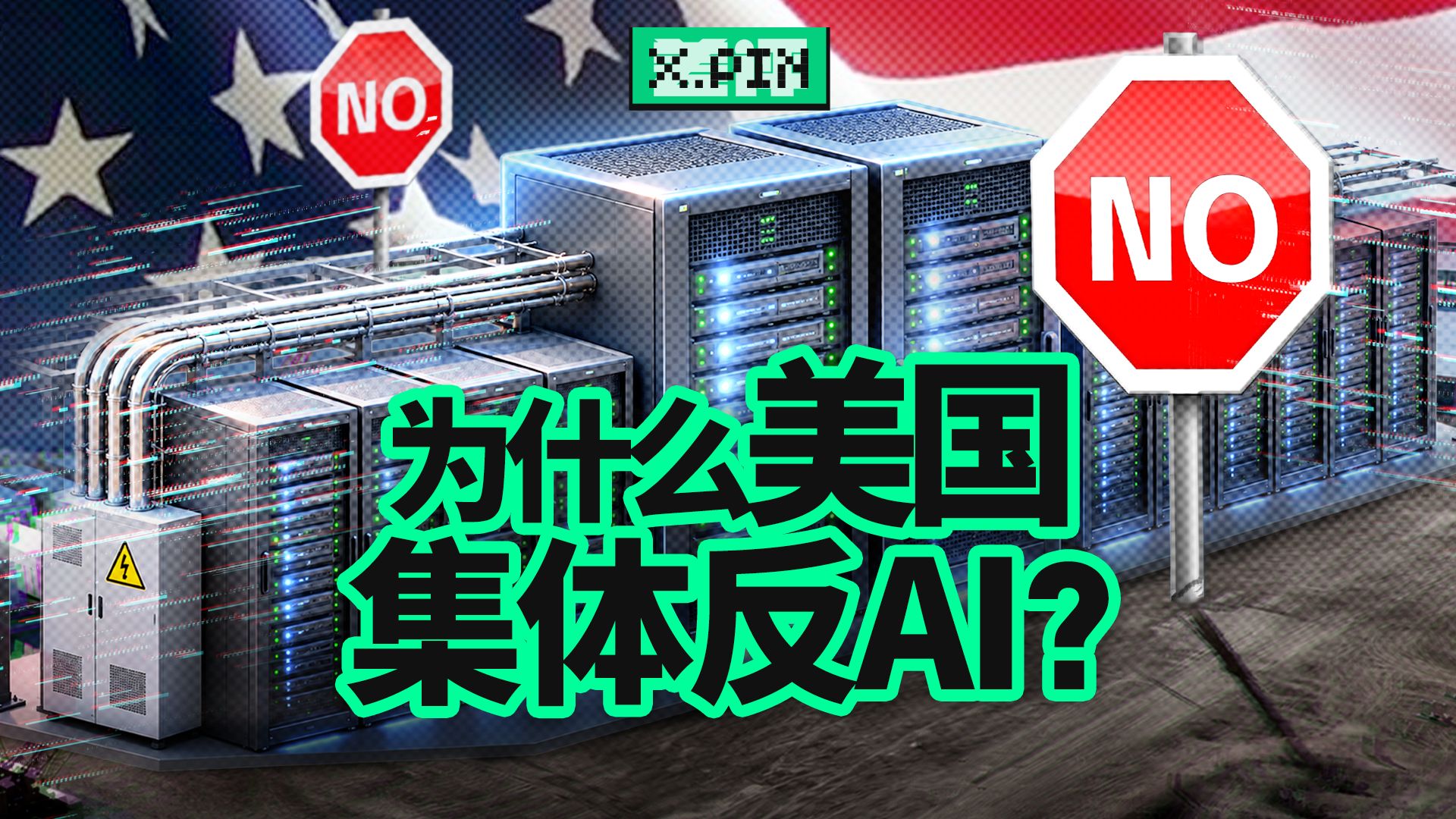
The whole of America was turned upside down—Nasdaq plunged. Yesterday's U.S. stock market was thrown into complete chaos by a midterm election.
In September of this year, the U.S. Democratic Party announced a bill to ban artificial superintelligence, declaring a comprehensive crackdown on the development of superintelligent AI.
The bill explicitly prohibits any individual, company, or organization from developing or deploying artificial superintelligence, even placing superintelligent AI on the same level as nuclear weapons.
Originally, the bill sounded like politicians making a radical proposal, but yesterday, when the midterm elections ended,
the Democrats won majorities in both chambers of Congress, and the market suddenly realized: uh-oh, this bill could actually pass.
As a result, AI industry chain stocks plunged across the board. The Nasdaq fell 5.5% in a single day, and Nvidia dropped 9%.
AMD fell even more, by 17%, and the Nasdaq 100 index lost $2.5 trillion in market value in one day.
And the place where the Democrats' anti-AI sentiment is most concentrated happens to be the part of the AI industry's expansion that burns the most money, consumes the most resources, and most easily provokes opposition from local residents: data centers.
Hello everyone, this is Chapinjun. Today we're going to talk about how data centers in the United States gradually became public enemy number one.
If you know a bit about data centers, you surely know that the United States is the country with the most data centers on the planet.
According to DataCenterMap's statistics, more than one-third of the 11,102 registered data centers worldwide
are in the United States. Looking only at hyperscale cloud provider data centers, 15 of the top 20 globally are in the U.S., and the number one spot within the U.S. belongs to Northern Virginia—quite different from the current situation.
Northern Virginia used to be extremely welcoming to data centers.
In the 1990s, the area had a large stretch of undeveloped land, with cheap land prices and low electricity rates, and it sits right next to the capital, Washington, D.C.
The capital had enormous government and military communication needs.
Internet service provider America Online, backbone network operator UUNET, and the internet exchange point MAE-East successively set up nearby, and vast amounts of fiber-optic cable were laid underground.
Cheap land, dense fiber, stable power, and a large base of customers on the East Coast—it instantly had all the makings of perfect timing and location.
Land that nobody wanted before could now attract large-scale investment and become a stable source of tax revenue.
How was that any different from money falling from the sky?
So Virginia began actively courting data centers. In 2010, the state passed legislation exempting data center servers and other equipment from sales and use taxes.
Big companies immediately flocked in, and Northern Virginia ultimately became the world's largest data center cluster.
For example, in Loudoun County, the tax revenue brought in by data centers greatly expanded local finances, allowing the new government to rely less on residents' property taxes.
As a result, the property tax rate was cut by nearly 30%—a home valued at $500,000 could save about $1,700 a year.
Back then, building a data center in the U.S. was basically like putting an elephant in the fridge: find a plot of land, put up a building, connect the power, stuff the servers into racks, and start running.
The most crucial thing was that power would never be a problem.
From 2010 to 2014, U.S. internet and cloud services were booming, yet total data center electricity consumption rose only about 4% over those four years.
Back then, even large data centers were only twenty or thirty megawatts—something the grid could easily handle.
Tech companies got cheap land and stable power.
Local governments got tax revenue, residents paid less property tax—this was originally a win-win-win story of tech companies driving local development, benefiting everyone.
Until the AI wave arrived, and tech giants began pouring money into data centers at an unprecedented pace.
Just the planned capital expenditures of Amazon, Microsoft, Google, and Meta combined this year amount to roughly $700 billion, about double last year's figure.
Moreover, AI data centers consume electricity on an entirely different scale than before.
Hyperscale AI data centers are routinely 100 megawatts or more, far exceeding the power consumption of ordinary data centers.
According to a U.S. Department of Energy report, U.S. data center electricity consumption rose from 58 billion kilowatt-hours in 2014 to 176 billion kilowatt-hours in 2023—a threefold increase over nine years.
And in Virginia, where data centers are most concentrated, a quarter of the entire state's electricity is consumed by data centers. An industry whose power usage barely grew before
suddenly became the fastest-growing major customer on the grid within just a few years, and the grid immediately couldn't keep up.
In Northern Virginia, large data centers above 100 megawatts can wait up to seven years from application to power connection.
According to publicly reported figures, across the United States, data centers wait an average of about four years to get connected to the grid.
And precisely because the application process takes so long,
and since most of today's AI data centers aren't particularly latency-sensitive and can be located anywhere,
many developers choose to take the same project and queue up simultaneously with several power companies across several states—whichever connects power first and offers cheaper electricity wins.
Then these developers suddenly discovered: hey, wait a minute—flipping land with power access seems more profitable than actually building anything.
According to statistics from the real estate investment firm F9 (as cited), in Northern Virginia, an acre of land that has been rezoned but not yet connected to power is worth about $4 million.
Once it can be connected to power, each acre is worth at least $6 million, and the land price is positively correlated with power capacity.
Another consulting firm, Atlas Group, found that plots that can connect to 230 kV or 500 kV high-voltage lines
sell for 2.4 times the price of plots that can only connect to lines of 138 kV or below.
This gave rise to a group of people I call the "data center land-flipping syndicates."
Their playbook goes like this: first, spend a little money signing options to lock up a plot of land near high-voltage power lines.
Then apply to the power company for electricity; once the power connection shows signs of progress, package up the land with power access and sell it to a tech giant.
One of the most successful players here is CloverLeaf. According to a New York Times report, it locked in advance the purchase rights to a 1,900-acre plot with access to 1.3 gigawatts
of power, then flipped it to data center developer Vintage for $200 million.
A campus with a total investment of $15 billion was later to be built there for Oracle and OpenAI.
A business this profitable naturally draws more people in.
The result is that power companies are now flooded with inflated, duplicate power applications.
The vice chairman of a power company's data center business said in an interview that roughly half of the large-load electricity applications in Texas come from these speculative developers.
Texas utility NRG put it even more bluntly: the whole process has been exposed, and a secondary market for grid connection slots has already emerged.
For these projects that squat on the spot without doing anything, the media came up with a rather fitting name: ghost data centers.
Of course, the utilities aren't fools.
Ohio utility AEP originally received data center power intentions exceeding 30GW; in 2025 it introduced new rules.
Under the new rules, after signing, a project must pay electricity fees for 12 consecutive years based on minimum requirements, and withdrawing midway means compensating for 3 years of electricity fees.
Once the new rules took effect, the projects willing to proceed shrank to 13GW.
In the end, only 5.6GW actually signed contracts under the new rules.
Now similar thresholds are appearing everywhere, and the bar for formally locking in power is genuinely getting higher and higher.
But the root cause of this chaos in the first place is that electricity isn't being used.
Precisely because electricity is scarce, a grid connection slot is valuable, and that's why people hoard and speculate on it. The ghost data centers merely expose an existing problem.
So, what is the real solution? Expanding the power supply. Expanding the power supply sounds like nothing more than building a few more power plants and laying a few more transmission lines.
China's "East Data, West Computing" initiative first designated eight national computing hubs and ten data center clusters based on energy, land, and network conditions, then guided large projects to concentrate in these regions.
But the United States has nothing like "East Data, West Computing."
There is no unified plan that first designates national-level computing hubs and then concentrates and matches energy and network resources.
The US mainland grid is mainly divided into three nearly independently operating systems: the Eastern, Western, and Texas grids, which can only exchange a small amount of power with each other.
Within each grid system, there are different regional dispatch organizations, state regulatory centers, local utilities, and private power plants.
To build a data center, you usually need to coordinate project by project with local utilities, regional grids, and state governments, layer by layer.
In many cases, site selection has to be constantly adjusted based on where power can be supplied first.
But for a data center to get electricity, there needs to be a power plant upstream, transmission lines in the middle, and a substation at the campus gate.
Any one of these three is slow to build in the US. Power plants involve queues—there are actually quite a few parties in the US that want to build power plants.
Last year alone, power generation and storage projects waiting in line for grid connection totaled 2,060GW, but most of them are still on paper.
The median time from application to power generation is over 5 years, and only a little over 10% actually get built. Transmission lines are even slower.
A cross-state high-voltage line meant to carry wind power from Wyoming to the American Southwest submitted its right-of-way application at the end of 2007.
It only got its construction permit in 2023, and won't be energized until 2030.
Even the large transformers inside substations now have delivery times of around four years.
At this point, some readers will probably ask: under the American system, with grid upgrades this slow, can't we just do it ourselves?
Let's try. The simplest approach is to build the data center right next to a power plant and just run a line over. That doesn't necessarily work either.
In 2024, Amazon wanted to build next to a nuclear power plant in Pennsylvania.
It wanted to raise the data center's power from 300MW to 480MW, but was rejected by the Federal Energy Regulatory Commission.
The reasoning: if you use the stability of the public grid, you have to pay for the public grid.
In the end, Amazon had to renegotiate its contract, with power routed through the public grid, paying the full transmission and distribution fees.
Going a step further: just build my own power plant and generate my own electricity, right?
Many people are already doing this.
According to Global Energy Monitor, in the first half of this year, gas-fired power projects dedicated to supplying data centers in the US nearly doubled.
Texas alone has 77GW of gas-fired power projects planned to directly supply data centers.
But generating your own power also requires permits first.
To get its Memphis data center online quickly, Musk's xAI deployed about 35 gas turbines, but the local authorities later only approved 15.
Even with a permit, gas turbines themselves involve queues—orders are booked out to 2031. So what about going one step further upstream?
Nvidia has taken stakes in three power and land development companies within a few months, directly grabbing land that already has power access. SpaceX is building a factory in Texas.
to cast its own gas turbine blades. From running a line, to generating its own power, to making its own turbine parts.
American tech companies have tried virtually every path they could think of, but every path takes time: grid connections require queuing, building plants requires permits.
Even running a single line requires a federal agency vote. Every step involves piles of procedures, and at every stage someone can pinch you.
What's worse, the gaps the grid can't fill.
Many of these burdens ultimately fall on residents living near data centers, to the point that the public is getting fed up.
In China, large data centers are usually built in pre-planned industrial parks or computing hubs, with electricity usage and planning determined in advance, and industrial land kept well separated from residential land.
But in the US, because the grid was historically built around human settlements, and data centers tend to seek plots that already have power, these data centers like to be built right next to residential areas—which is a bit of a problem.
Let's tell a story. The person in the picture is named Lindsay, who lives in Sterling, Virginia—that is, the Loudoun County mentioned earlier.
A few years ago, she and her fiancé bought a house there.
In 2022, data center company Vantage announced it would build a campus on an empty lot near her home. Lindsay was initially supportive. Her exact words were—
and Loudoun County lowered property taxes, and her household was one of the beneficiaries.
But after the campus started up, things began to go a bit wrong. Because power couldn't be connected in time, the campus was put on a waiting list for electricity.
To start construction first, Vantage installed 8 gas turbines on the campus, generating its own electricity around the clock.
Lindsay said the whine from the turbines was so loud that even with the TV on, it couldn't be drowned out—not even at 3 a.m.
At night, the campus lights shone directly into her home. When the backup diesel generators started up, exhaust fumes drifted toward nearby homes. The property tax cut was nice, but Lindsay felt these benefits weren't worth the trouble. A reporter asked her whether she would simply move away.
Of course, I could move away, but what worries me is that you can't escape it—data centers in the US could be anywhere. It's not that data centers have already filled up the entire country; it's that one could pop up in any location.
She moved away today, but who's to say the vacant lot next to her new home won't become the site of the next data center someday.
Lindsay is not an isolated case. A poll in June this year showed that only 14% of Americans would be willing to have a data center serving tech companies' AI projects built in their own community.
More than 840 local groups opposing data centers have sprung up across the country.
Every state except Hawaii has data centers, and there is a core contradiction: local residents actually get very little benefit.
The people who actually use them are often in big cities thousands of kilometers away, or even abroad. After a data center is built, the long-term jobs it brings to the local area are often fewer than 100, yet residents have to endure the noise, lights, and waste right at their doorstep.
Even people living farther away can't escape the electricity bills.
In China, residential electricity prices are set by the government and have been lower than industrial and commercial rates for decades—effectively meaning industrial and commercial users subsidize residential electricity.
But in the US, the costs of expanding power plants and the grid are spread across every household.
PJM, the largest regional grid operator in the eastern US, holds a capacity auction every year, locking in generation capacity in advance to handle peak demand on the hottest days a few years out.
In July this year, PJM's auction for 2028–2029 cleared at the price cap of $325 per megawatt per day across the entire region—the third consecutive time it has hit the ceiling.
Even with prices at the ceiling, power reserves still fall short of reliability requirements by about 6.8 GW.
Since May 2025, PJM's capacity prices have risen more than tenfold.
In the first seven months of this year, wholesale electricity costs in the PJM region rose 46% year over year.
What's truly infuriating is that PJM's independent market monitor did the math: power companies included a large batch of speculative data centers that haven't been built—and may never be built—in their future electricity demand forecasts, which pushed up the price of last December's auction by 61%.
The calculation showed that this will cost ordinary users more than $47 billion.
In other words, those speculative projects hoarding grid connection slots have ultimately turned into real electricity bills for ordinary families.
You build your data centers, fine—but jacking up my electricity bill, what kind of deal is that?
As for the water usage issue, we made a dedicated video about it before. Interested viewers can go check it out; we won't go into it here.
So at the end of the day, building data centers in the US is difficult largely because the costs fall on the smallest units: a county, a community, a single household's electricity bill. These costs have become real burdens, while the benefits from data centers are hard to come by.
Even Loudoun County, the biggest beneficiary, is starting to struggle. About 45% of Loudoun County's government budget comes from taxes paid by data centers, yet even this county that depends on data centers the most—
in September this year, a majority of the county council voted to consider a moratorium on approving new data center applications, for up to 12 months.
That decision was later postponed to November 17 for another vote.
This is also why AI and data centers became an unavoidable issue in this year's US midterm elections.
The data center dilemma the US now faces can hardly be blamed on any single point of failure.
The scarcer electricity becomes, the more valuable grid connection slots are; the more valuable the slots, the more ghost projects speculate on them. The more ghost projects there are, the less willing power companies are to expand the grid in advance; when the grid can't expand, data centers have to generate their own power and grab their own land, ultimately dumping noise, exhaust, and electricity costs all onto nearby residents.
These problems feed into each other, forming a knot that is very hard to untangle.
And the most frustrating part is that the consequences are borne by locals, while the benefits barely reach them.
It's true—with AI, making spreadsheets and writing documents has gotten a lot faster, but the numbers on your paycheck don't seem to have grown accordingly. The people who benefit are in Silicon Valley, on Wall Street, or even far, far away.
The reason the Democrats achieved this epic victory is precisely that they translated the Trump administration's AI and infrastructure slogans into a question that resonates more with voters:
Why should tech companies take the profits while ordinary residents foot the bill for grid expansion and rising electricity costs?
Judging by the current situation, after several years of sprinting, AI may indeed need to slow down for a while.
But I don't think that's a bad thing.
No matter how much a technology claims it will revolutionize the era, in the end it has to answer the most basic question:
What does it actually bring to ordinary people?
Alright, this is Chaoping Jun, and that's today's content.
If you enjoyed it, feel free to like, coin, and favorite.
If there's anything you'd like to say, interact with us in the comments and bullet chats, and finally, please follow us.
You can also follow our channel "Chaoping" (差评). See you next time.